

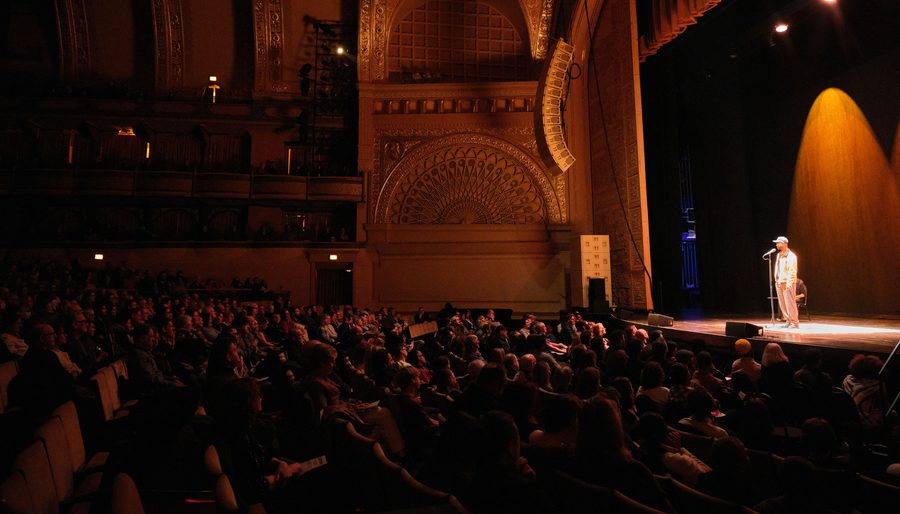



One man’s love brings out the worst in his family.
“I left them thinking that my Japanese wife had invested me with some oriental mystery.”

Transcript
Marvin Gelfand — Anger
My father escaped his icy, neurotic Bronx Jewish family into the arms of what he thought was a welcoming, huge, warm mishpocha. Yiddish, I guess, for mob. And that was the Mustinsky clan of Williamsburg in Brooklyn. Took him a while to learn what he’d gotten into. I, from my early youth, was planning my escape from this immigrant group who I thought was ghetto minded and insane, backstabbing, petty fights, screaming. I just never understood what these 12 brothers and sisters and the in laws were about.
My escape was not particularly clever. First, it was books, and it remained books for a long time. And sports. I wasn’t a bad baseball player. Not very good, but determined. And then, of course, education in general, which my parents would have loved. That was the way Jewish immigrants thought you’d go onward and upward. Going away to school helped as well. Little did I know that my deliverer would be a teeny Nisei woman, Japanese-American, who I met on the steps of the Columbia Library, Low Library, in 1955.
May Ebihara come from Portland, Oregon. She was teeny to begin with. Caught TB of the spine when she was in one of our concentration camps in World War II, and had scoliosis pretty badly. She was also a heathen, as she described herself. When an anthropologist says, “You’re a heathen. You’re a heathen.” It was instant love for me. Plus, something from Chaucer– I forget one of the characters had a belt that said “Amor vincit omnia.” Love conquers all.
I was the romantic of the two of us. She never expected we’d marry, that I could cut the apron strings. But when she went off to Cambodia to do her fieldwork, we corresponded and I realized I couldn’t live without her. So, I proposed. We came back. The family heard about it. Anger isn’t the word. It was as furious as the World War III that a lot of people expected to come around the corner. So, the iron door slammed on us. I had my Jap– It wasn’t that much after the Second World War. But no Jewish-American princess she. [audience laughter]
Anger or no, we went off to teach together. We had two beautiful sons that got her looks. Came back to New York. My wife finished her PhD. I did not mind. Got into literary journalism, and went to the ballet and the opera and plays. And on occasion that iron door would creak open at teens. And in a meeching gesture of reconciliation, we’d be involved to a bar mitzvah– Invited, excuse me, to a bar mitzvah or a wedding, of which there were many. We were always seated at the children’s table. [audience laughter] I would go into tirades of fury, you know, my mean small-minded relations. And May would just look at them with great generosity of spirit and an anthropologist eye. She would ask me questions about my family that I never thought to ask. You know, nothing got to her, nothing could.
There was one couple in the family, my mother’s youngest sister– big hearted neurotic– who married a Lower East Side guy, World War II vet. And they were tough, no high school education and the rest, but quick street smart. We would meet, talk amiable trivia, have a drink, and then go to a restaurant that my uncle knew. He just was a genius about great restaurants in New York. And we did this for years. And one day, they called and said, “We’re coming town, we’ll be shopping.” I said, “Let’s meet at Peacock Alley in the Waldorf.” I could sense on the phone he was thinking, these rare birds are going to come out and humiliate us now. The Waldorf didn’t say it, but I knew it. And I said, “No, great piano player there. It’s not expensive, and we’ll meet.”
I meet them. The piano player, marvelous fellow named Jimmy Lyons throws me one of these and a big smile. I looked at my uncle and he said, “Oh, it’s going to come.” They’ve gotten this in way over our cultural heads. They were so thin skinned and sensitive about that kind of thing. Well, in any event, May was late, and very late. And being my relations, they got angrier and angrier because they thought she had been flattened by a taxi cab or finally was standing them up. Jimmy is playing away on Cole Porter’s piano. Huge bass, beautiful sand. He shifts from a Cole Porter song into a Gershwin song. We could not see the entrance from where we were sitting, my uncle, aunt and I. I said, “May’s here.” He said, “How do you know May is here? You can’t see the entrance.”
The captain pops her around the high banquet. And she says, “Hello, I’m sorry I’m late.” “How did you know she was here?” say my relations. But the amiable trivia had begun. So, I left them thinking that my Japanese wife had invested me with some oriental mystery, [audience laughter] that we had something going, that I would know where she was and she me. Well, for years and years the amiable trivia lasted. The anger in the family never relapsed.
I guess I have to tell you what the song was, our song that Jimmy knew. I can’t remember all the lyrics, but some of them I do. It went, I’m yours, you’re mine. And in our hearts, the happy ending starts. What a lovely world this world will be, with the world of love in store for you, for me forevermore. Forevermore for me and May Meiko Ebihara lasted close to 45 years. She died April 23rd, 2005, to be beyond. Oh, hell, she was always beyond the mean bites of soul shrinking anger. Thank you.