




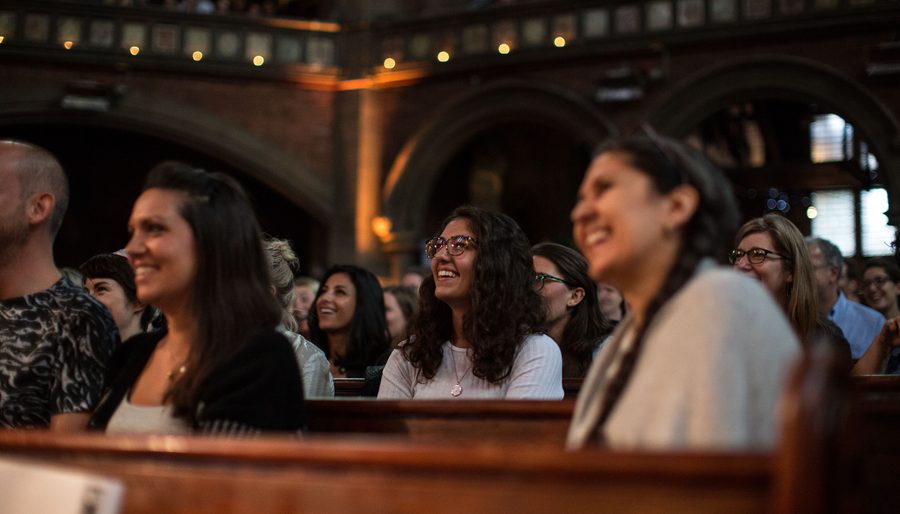

An English woman has to answer a tough question on her US citizenship test.
“I decided to become an American citizen after thirty three years in this country.”
Photo by Jason Falchook

Transcript
Mel Dockery — Cannot Tell A Lie
In 1997, I decided to become an American citizen after 30 years, 33 years, actually, in this country. And the reason that I did it, I thought, was for a really basic and intrinsic American value, financial greed. [audience laughter] Now, there are a lot of rules that you had to comply with obviously, if you’re going to become a citizen, fingerprinting, eligibility, who you’re married to, endless things. Have you ever been arrested for a serious crime? And I managed to crawl through all of those. And the final two things that I had to pass were the civics test and the interview to see if I was an eligible puddled mass to come into America. [audience laughter]
So, I have to explain about the civics test in those days. I think they have lessened the number of questions now. There were a possible 300 questions that you had to be able to answer, and they were going to ask you 10 of them. So, I was a little disappointed at the interview when he said, “Who is the current American president?” “Clinton.” “What color is the flag?” “Red, white and blue.” “Name two states other than New York and New Jersey.” [audience laughter] I picked Oklahoma and Arkansas, trying to make it a little bit harder. [audience laughter] And then he said, “Who discovered America?”
Now I know that another intrinsic value of America, because it was the founding Father that said it is thou shalt not tell a lie. So here I was, stuck. Who discovered America? I wanted to say, “Well, the first person that stood erect out of the primordial slime, I suppose,” but I thought that wouldn’t be a good way of phrasing it. So, I said, “The first people who were here,” [audience laughter] I could tell he didn’t like it. And I said, “Well, I know, I know you want me to say Christopher Columbus, but that is politically incorrect.” [audience laughter] Somehow, I managed to drag myself through the civic stage and we came to the interview and it started off really well. We had some pleasant conversation and I thought, I think this guy likes me. And then he said, “Will you be prepared to bear arms for the United States of America?” And I said, “Well, again, can’t tell a lie. I couldn’t kill anyone.” And he said, “Why not?” [audience laughter] To be an American citizen, I have to say I’m going to kill somebody. But anyway, I said, “I don’t know, I just couldn’t.” And he thought a bit, and I thought a bit and he said, “Do you belong to a religious organization that forbids killing?” And I said, “No.” [audience laughter]
Then he leant across his desk and sotto voce, he said, “How old are you?” And even softer, I said, “55.” So, he leant back and then he leant forward again, and even softer, he said, “It’s highly unlikely [audience laughter] that you’ll have to fight.” [audience laughter] Hey, presto, “I said, fine.” And he put a big check mark, next to bear arms. So just know that if there’s a war that breaks out and I’m carrying a gun or carrying the landmine, that’s all I do. And somehow, miraculously, I became a citizen of the United States of America.
And about a week later, yes, Yay. About a week later, I had to fly up to Boston on the Boston shuttle. And of course, Boston, you have to fly around because you get stuck in traffic. And I look down and I see Boston harbor sparkling in the sunshine, and I start to cry. My harbor, my tea party. [audience laughter] And I realized that I became an American citizen for more than just financial greed. Thank you.