
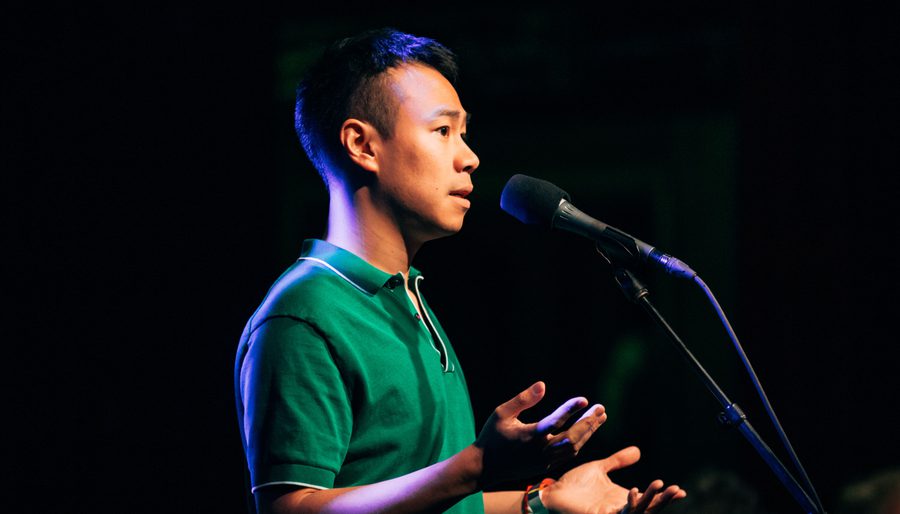
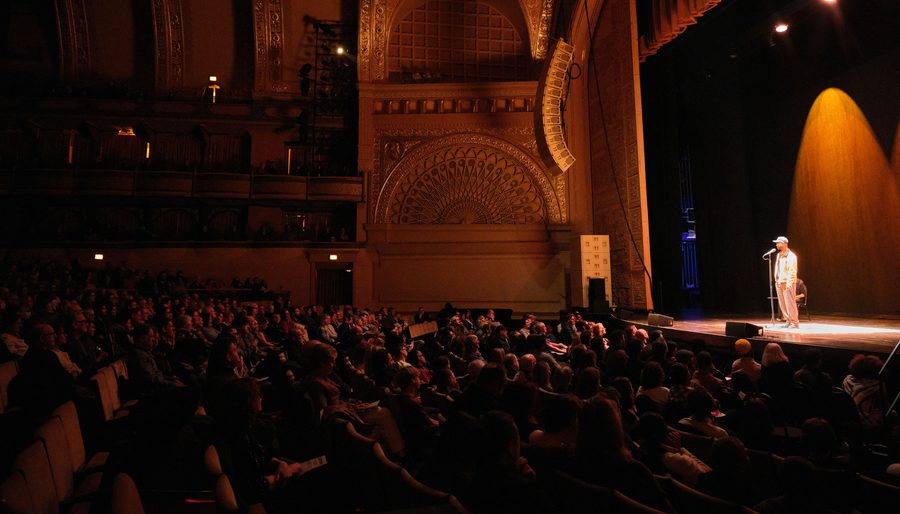



Ayisha Irfan finds herself in the awkward role of the “office Muslim.”
Storyteller
Original Air Date
Recorded Date
“I was brought in as a senior advisor on racial justice issues, lots of them in New York. And I also happened to be the cool office lefty Muslim.”
Photo by Jason Falchook

Transcript
Ayisha Irfan — Cool Lefty Muslim
So, I work for an elected official here in New York City. My day is a perfect blend between House of Cards and Parks and Recreation. [audience laughter] We are equally trying to take over the world and fight the New York City rat problem. Really, really interesting days in government. And my coworkers, there are about 55 of us, mostly former organizers and activists and folks who genuinely want to use government as a force for good. Most of us are also staunch anti-institutionalists, who’ve suddenly found ourselves inside the very institution we hate. [chuckles] So, that does something to us.
I was brought in as a senior advisor on racial justice issues. Lots of them in New York. And I also happen to be the cool office lefty Muslim. [audience laughter] What does that mean? I wear really colorful hijabs. My outfits are super coordinated. I swear on occasion. It’s great. It’s great. [chuckles] I think having me around makes my coworkers feel a little bit less racist about themselves. [audience laughter] So, there’s that.
I also seem to have adopted the profile of the office Muslim. So, anytime there’s anything where our office has to prove that they’re diverse and inclusive, I’m the first person they send along the way. And the way I’ve tried to combat this pressure of representing over 1.1 billion people across the world [audience laughter] is every time there’s a job opening, I’m bringing my folks in. [laughs] I’m bringing other Muslims to the table, I’m really working hard to transform the rooms I’m in, the tables I have access to. And so, that’s been great.
I’ve brought in four other people. And my coworkers, we’ve created a really warm, positive, welcoming culture most days. And so, one of my favorite coworkers is this woman named– And if you look at us on the surface, we really couldn’t be more different. She is in her 50s. She grew up Jewish. She’s now a practicing Buddhist. I’m 29, I’m Muslim. But both of us are staunch, just haters of capitalism and militarism. So, we bond over that all the time. We talk about our histories in the anti-war movement. For her, it was Vietnam. And for me, it was the anti-Iraq war movement when I was coming of age.
And so, one day, a few months ago, I found myself in her office, as I often am, leaning against her door, just catching up. She brings up the Mike Pence article that had just come out in The New Yorker about how Mike Pence doesn’t dine alone with women who aren’t his wife. Now, I don’t agree with Mike Pence on just about anything on the face of this earth, but this piece around interactions with people of the opposite sex– I grew up in Brooklyn, New York, around a lot of really conservative Muslims, around a lot of practicing Jewish folks. So, this piece resonates. And I say, “Actually, in terms of dining alone with people of the opposite sex, a lot of the folks I grew up around, that I’ve been in school with, they abide by really similar principles. It’s not seen as something that’s inherently evil, or like women are dirty or men are dirty. This is just the way people choose to practice their faith.”
[clears throat] And so, then I actually go on and I say, “Actually, I know a lot of folks who don’t even shake hands in professional settings with the opposite sex, and that’s their way of practicing their faith. And for the longest time, my mom, when she entered the workforce, she didn’t. And by extension, when I was 22 years old, I didn’t either, until my own views on this evolved personally.” And so, she stops and she turns and she looks at me and she says, “Anyone who doesn’t shake hands with the opposite sex never, ever belongs in a managerial position.” And I say, “What if I told you I didn’t shake hands with men? I didn’t used to. What if I told you, like, starting today, I’m not going to do it anymore?” And she looks at me and she says, “No, but you’re different.” Okay. [laughs] I’m different than the 1.1 billion other Muslims out there. Let’s think about, like, just the mathematical possibility of that being the case.
But what that also tells me is you haven’t been around very many Muslims. Because this phrase, I’ve heard it consistently in a lot of my interactions with non-Muslims. And so, I stop and I pause and I think, “How do I even begin to unpack this statement of ‘you’re different’ and what that means and what pressure that puts on me?” And I’m thinking of a response when another coworker walks in and the conversation just stops right there. I leave the office that day and I start thinking about how I had been showing up as a Muslim American in this office space, and I had been really centering my own faith in the interactions I’d been having over the course of three years with my coworkers.
I realized that one of the daily pillars of Islam, is that you pray five times a day, and you take a few minutes, you remember God, you get connected and grounded. And the way I’d been doing this really important pillar of my own faith was I’d been sneaking off into the corner bathroom, quickly washing my hands and my face, afraid someone would walk in on me, I’d be ripping off a sheet of paper towel, running into the corner closet that hadn’t been cleaned in 20 years, and praying within a span of two minutes, afraid that someone would catch me.
And so, I had a moment where I realized I hadn’t been doing my part. And if I was performing all of these prayers by myself in a corner closet, all of these people that I had brought in with the very intention of changing the culture and making these spaces more welcoming, I was completely failing. And so, I went back to my chief of staff a few days later– She started talking about an empty room that we were converting into a maternity space for a lot of my coworkers who had recently given birth and needed lactation space. I turned to her and I was like, “Jessica, I don’t know if you know, but for the last three years, I’ve been praying in that dirty back closet over there, and these four other people I’ve brought in are actually doing the exact same thing. Can we talk about turning this space into a meditation space? So, it’s both a lactation space, but also we can pray in a space that’s worthy of God and worthy of worship.”
She looks at me, and you could tell she had never thought of this before, and she whips out the floor plans for this new space, and we start thinking through where everything’s going to be placed. And so, I go home that night, and the next day I pick out my favorite prayer rug that I’d been using to pray at home– It’s beautiful. It’s royal blue. It has golden embroidery. There are minarets all over. I brought it into the office. A few weeks later, as it came time for prayer, it was the Asr prayer, which is the evening prayer, I gathered my four other coworkers– And instead of putting the prayer rug out vertically, as we usually do for one person, we laid it out horizontally, so it could fit more people, and the four of us prayed together. [laughs]