



A man finds humor can make the darkest situations more bearable
Storyteller
Recorded Date
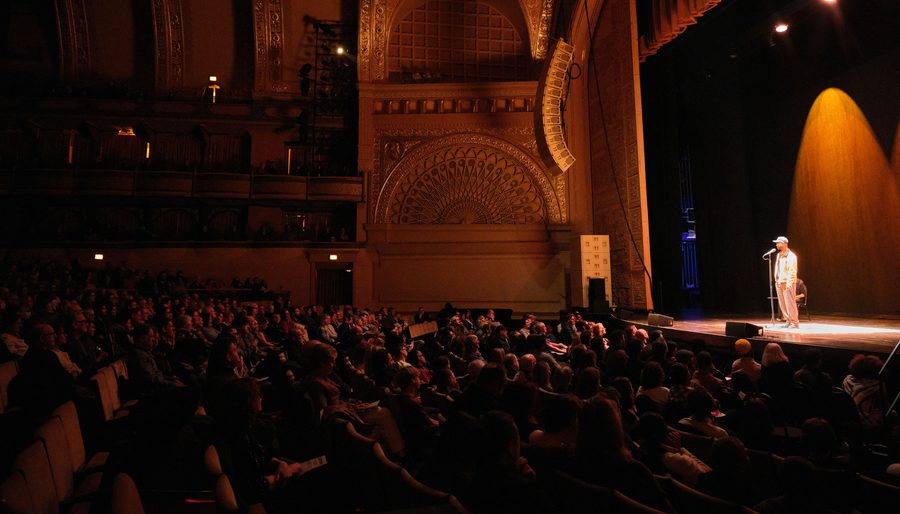
“In senior year of my high school, all the cool kids went to Auschwitz.”
Photo by Sarah Stacke

Transcript
Shalom Auslander — Death Camp Blues
So, just a little bit of background. I was raised in an ultra-orthodox Jewish community and spent my childhood in yeshivas, which are orthodox religious schools, yarmulke, tzitzis, the whole thing. In senior year of my high school, all the cool kids went to Auschwitz. [audience laughter] It was sort of a rite of passage to go to a death camp. [audience chuckle] And so, some went to Treblinka. Dachau was a real schlep, nobody went there. [audience laughter] Everyone went to Auschwitz, and I didn’t.
At this point in my life, I’ll be honest, I was raised on all that graphic newsreel, corpse pile, mass grave, horrifying imagery from a very young age. And at this point, I was sick of the Holocaust. I never wanted to hear about it again. The only thing I hated more than Nazis was hating Nazis and my mother, [audience laughter] who was a very, very melodramatic woman who just adored misery. She was never happier than when she was miserable, and never more miserable than when she was happy. [audience laughter] And she never went through the Holocaust, neither did her parents. But I always got the sense that she’d have been happier if she had. [audience laughter]
At least there’s something to talk about around the dinner table. And so, I decided not to go. So, we were in Europe, and all my friends went to Auschwitz, and I went to the Louvre. So, that’s the background. So, a couple of years ago, I found myself in Berlin, and I was turning 40, or close enough to it to feel like I should really go to a concentration camp. It’s time. [audience laughter] I don’t know what that means, but I felt like it was time to go to a camp. And so, I decided– fortunately, there was a death camp just a half hour outside of Berlin [audience laughter] called Sachsenhausen. And I was thinking about going to Auschwitz, but this actually crossed my mind, “Oh, it’s such a train ride, it’s just going to kill me.” [audience laughter]
And so, I decided I had– was my last day in Berlin. I had to– it was my last day. I had to make an afternoon flight, and I only had a few hours in the morning, but I decided I should really go before going back. And so, I only knew one woman in Berlin at the time, and I asked her if she wanted to come along. You know, sunny skies, nice day, let’s go hit a death camp. [audience chuckle] And she said no, surprisingly, and she said no because she was German, and she’d been– she’d been to Sachsenhausen five times. She’d been to Auschwitz half a dozen times, because in Germany, all the schools get together and every year they take the children to another concentration camp. One year Auschwitz, one year Treblinka, so that by the time they graduate, they really hate Jews [audience laughter] all over again.
So, she said, “No, thanks.” But she did give me one piece of advice. She said– and this is what she said. She said, “Give yourself a day. Give yourself a day. It’s a big place, there’s a lot to see.” And I said, “Well, I can’t. I have to get back for a train. I’ve only got a couple of hours.” So, her follow-up piece of advice was, “Well, then skip the ovens.” which is an interesting thing to hear in a German accent. [audience laughter]
Apparently, everyone goes and wants to see the ovens. I don’t know why that is. I don’t know what it says about people, but they all want to go see the ovens. It’s like Epcot at Disney, you’re going to ruin the whole day. And I don’t know what it says about me. For me, I wanted to see the gas chambers more than anything. I think it was like my worst imagery, my worst nightmare because, for one thing, I always pictured being in one with my mother and she’s just saying, “I told you so,” the whole time. [audience chuckle] And then we die, thankfully. [audience laughter] So, I said, “You know what? I’m going to go. I’m going to wing it.”
So, I go out there, I go out to the camp. I get there about 10:00, but the ticket line is– whatever, it’s 10:30. There’s a gift shop. [audience laughter] I swear there’s a gift shop. And then there’s this long dirt road that you have to walk down to get to the actual camp. So, by the time I get to the gates, it’s like 10:45, 11:00. I’m down to two hours. I’m already pissed off. And I see the gates, and there’s that sign, “Work will set you free.” And my first thought is, “Oh my God.”
And then I walk through the gates, and I look around the camp, and I think, “Oh my God.” Because there’s just these roving packs of German teenagers in groups of 30 or 40 moving around the camp, and that’s it. And I don’t like seeing groups of Germans, even in the best of times. [audience chuckle] And in this particular instance, I only had a couple of hours, and I thought, “I’m never going to make it.” So, the first thing I did was I went– ignoring the advice, I went to the ovens. And as I’m walking there, I realized there’s this group of students who are trying to get there ahead of me. And their teacher’s hustling them along, and I kind of start fast walking, and they get there before me. And the line is– it’s out the door. It’s like an hour wait. And I wait on line, getting more and more upset. And I look at my clock. The line– it’s 20 minutes, the line hasn’t moved, and I’m starting to get more and more upset. And I’m like, “Oh, my God, fuck this.” I’m not going to let these ovens ruin my whole visit. [audience chuckle] And I leave, and I say, “I’m going to go see the Jewish barracks. And then I’ll hit– then I’ll go to the gas chambers, and then I’ll get the hell out of here.”
So, I start with– the gas chambers are all the way on the other side of camp. I mean, the Jewish barracks. So, I walk over there, and again there’s this group of students who– and this time they’re practically running to get there before me, just because they see that I want to get there, which is such a German thing to do. [audience chuckle] And then they don’t even want to be there. And I get there, and they beat me. And I’m on line, and I’m pissed off now, and the clock’s ticking, and they’re taking forever.
But I finally get in. And you walk in, and it’s this tiny, little narrow space, and the actual barracks are sealed off by this full plexiglass wall, and you’re not allowed in, and only a couple of people can fit there to see it. And I finally get up to it, and I’m looking at it, and I just lose it. I just– I’m crying. And I don’t even know about what. I don’t know why. I don’t remember the thoughts going through my head, but it was very horrifying. And so, usually at this point in the story, the storyteller says, “I don’t know how long I stood there.”
But I do know how long I stood there because somebody tapped me on the shoulder, and I turned around, and this German kid is right in my face going, “Zehn Minuten, zehn Minuten.” And the first thing I think is, “I’m going to start fighting with a German kid in a concentration camp and get thrown out of a camp.” [audience chuckle] And I kind of liked that whole story. [audience laughter] And I was thinking, “All right, all right, all right, buddy, we’re going.”
But then it occurs to me, it’s 10 minutes. I was probably out there for 25. I look at my watch, there’s a half hour left, and I think, “Oh, crap, the gas chambers.” And I run out. At this point now, I’m actually running across the camp. I don’t know that you’re allowed to run in a camp, but I’m running across the place. I’m looking for it, turns out I never did see the gas chambers because the fucking Nazis knocked them down before they left. And there’s nothing there to see.
So, I’m furious at this point. And I walk out, I leave the camp, and I’m just– I’m super pissed off. And I’m like cursing to myself, “Goddamn Germans, and wasted my whole time at the ovens.” And I start heading up the dirt road, leaving the camp and I get this vision of myself, this sort of third-person picture of what’s just been going on. And I just start laughing. I just start– burst out laughing. There are other people walking the other way who must have thought I was like Goering’s grandson or something, [audience laughter] but I’m just totally finding this hilarious, and in a really kind of liberating way. And two words crossed my mind– not, never again.
But the words were Tanta Henny. And Tanta Henny was my grandmother’s sister who died when I was 8 – 9 years old. And because my mother loved misery, she decided to have the shiva, the mourning, in our house, even though we lived out of the city. What could be more unfestive? So, they invite my grandmother to come to the shiva. And at this point in her life, she’s fairly far gone with Alzheimer’s disease. So, though they told her the day before that her sister died, by the time she got to the house, she’d forgotten, walked in, saw all the people, and naturally assumed it was her birthday, [audience chuckle] and starts thanking everyone for coming and going, “Oh, my God. Oh, my God, this is so nice. This is so wonderful.”
They bring her upstairs. I’m sitting on the couch, and lucky for me, my mother sits her down right next to me, and she starts asking me these Alzheimer questions, “Who are you? What is this place? Do you know how old I am?” And then my mother sits down beside her on the other side and says, “Listen, Ma, I have to tell you something about Henny.” And she says, “What is it? What happened?” She says, “Well, we told you yesterday. She died.” And my grandmother starts crying and bawling, saying, “Oh, Henny. Oh, Henny.” Crying and crying and crying.
And my mother sends me to the kitchen to get some water to calm her down. I get the glass of water. I come back, she’s already settled herself. I give her the water. She asks me who I am, where we are, and if I know how old she is, and things calm down a little bit. A cousin comes over, kneels down in front of her, puts his hand on her knee, and says, “Bobe, I have to tell you how sorry I am.” “Sorry about what?” “About Henny.” “What about Henny?” “That she died.” She starts crying again, saying, “Oh, Henny. Oh, Henny.” I run off, I get the water, I come back. This happened about four times. It was a little holocaust right in our living room. [audience chuckle]
And when it happened about the fifth time, a similar thing happened to me. The guy came over, said, “I’m so sorry for your loss.” She starts crying, and I started to laugh, and I felt horrible. And I covered my mouth, and I ran out, and I ran into the kitchen pretending to get water, and I turned around with this glass in my hand, and my mother’s standing there, and her eyes are all red. Always– I mean, not just– [audience laughter] and she’s been crying since 1947. And she says, “What the hell is so funny?” And I just turned around, and I laughed again. I just– like, “Why can’t you just tell her it’s her fucking birthday?” [audience laughter] And a miracle happened, my mother laughed. She stood there, and she laughed. And I thought, “Oh, my God, we’ve found common ground. We’ve come together in this, in these blackest gallows humor. This is fantastic.”
And she comes over to me, and she stops laughing, and she puts her hands on my face, and she says, “Zindala, I laugh so I don’t cry.” And then she started crying again. [audience laughter] And this is what I thought about on the road from Sachsenhausen back to the train– was that for me, laughter, particularly dark laughter, is a victory of sorts. I can’t imagine Hitler would have wanted anyone to walk down that road laughing at anything. I don’t think Alzheimer’s disease, if it’s a person or a thing, wants people laughing at it. And so, for me, it just felt like a release.
It felt very– again, very liberating. And I turned around, and actually, now that I think about it, that’s what all these stories here tonight are in a certain way. And I turned around and looked at the gate, and it said, “Work will set you free.” And I thought, “Well, they’re wrong about a lot of things, but that’s particularly heinous to me because, to me, laughter will set you free. Thanks.