

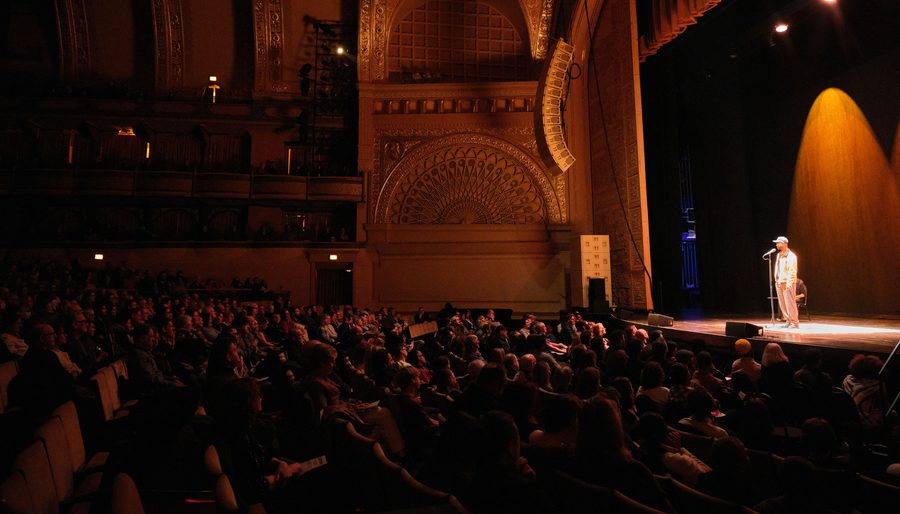


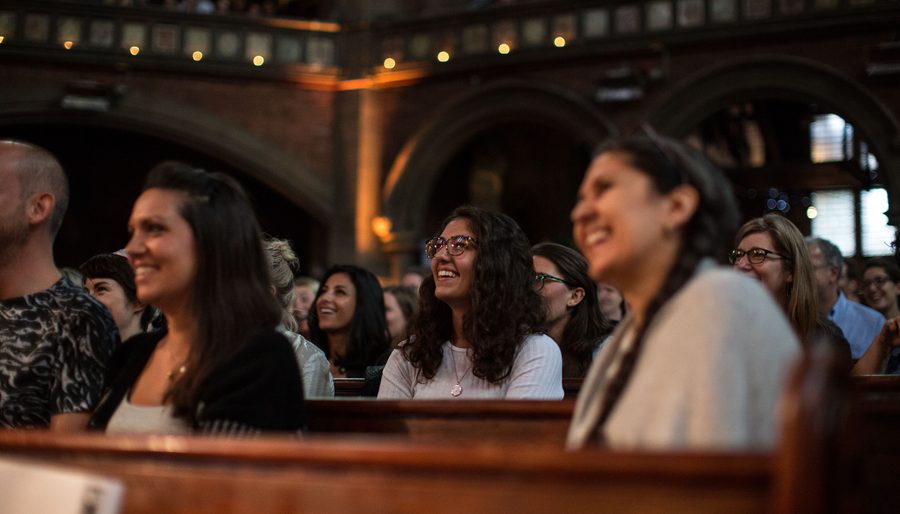

In this hour, money talks. Stories of finances — coin collecting, running grifts, and determining the value of “stuff.
Storytellers
Steve Zimmer and his father search for a rare penny.
Stacey Curry finds some monetary discrepancies at her new job.
Dannie Olguin grows up worrying that she will never have enough.
Taji Torrilhon does not place great importance on “stuff,” but her wife does.
Charles Caracciolo finds a financial incentive to being an altar boy.
Christian Garland, a preacher’s kid, steals collection plate money from his grandfather.
Hosted by
Moth Senior Curatorial Producer Suzanne Rust
The Moth Radio Hour is produced by The Moth and Jay Allison of Atlantic Public Media.

Teenage Stacey

Taji Torrilhon

Charles’ Communion May 1972 — 1

Charles’ Communion May 1972 — 2

Charles’ Communion May 1972 — 3

Transcript
Host: Suzzane Rust
[Uncanny Valley theme music by The Drift playing]
Suzanne: [00:00:14] This is The Moth Radio Hour. I’m your host, Suzanne Rust. I admire and envy the financially savvy. In most aspects of my life, I feel like a fairly well-adjusted, well-informed adult. But there’s something about talking finances, budgets, investments, 401(k)s, long-term goals that shuts me down. My New Year’s resolutions almost always include a promise to get better with managing money. And while I did fulfill that promise last year with a financial consultant, which was really helpful by the way, I still have a way to go before I feel as confident as I would like. I think all of this is what drew me to the theme of cents, as in coins, and sensibility, because I’m curious to see how others navigate those sometimes murky waters.
This hour is about money, but also about the things we value beyond it, like a sense of security, love, respect, and knowing when what we have is enough. Our first story was told by Steve Zimmer at a SLAM in Chicago where we partner with public radio station WBEZ. Here’s Steve live at The Moth.
[cheers and applause]
Steve: [00:01:23] 1973, I’m 10 years old and my dad works at a tool and die company which doesn’t pay much money. But he’s also an inventor, which pays negative money. [audience laughter] So, every night after dinner, he goes down to his basement workshop and I never follow him. I’m very similar to my father’s father and they really never got along. And that might be okay, except that my parents fight a lot and I get pulled over to my mother’s side, which just widens the rift between me and my father. Now my big new hobby is coin collecting, and mostly I read books about coins. But one night my dad comes home with a bag of $40 of pennies, pennies from the bank in paper rolls. And he lays them out on the kitchen table and doesn’t say anything, just starts sorting through them.
So, I join him, and it’s probably a first father-son activity. Now, when you’re sorting Lincoln pennies, the first thing you do is look for wheaties. Pennies predating 1959 with wheat ears on the reverse. So, now all of a sudden, every night, my dad and I are there after dinner sorting through pennies in complete silence, except for the periodic discovery of a wheatie, which causes the finder to say, “Wheatie.” [audience laughter] So, it’s like Rain Man with two Dustin Hoffmans. So, now one night I find a wheatie from 1943. Now, due to wartime copper shortages, ’43 pennies were made of zinc. They’re gray. But the penny I found is brown.
Now, there are 25 known specimens of 1943 copper pennies. A mint employee at the time illegally snuck them out. In the vast global world of coin collecting, [audience laughter] no one is more universally beloved than the unscrupulous mint employee. [audience laughter] So, this penny is worth triple the value of our house if it’s genuine. Now, the easiest way to counterfeit a ’43 copper penny is to copper-plate the zinc version. But the zincs are lighter, so all we need is a good microscale. And my dad decides that he’s going to build one, [audience laughter] since, as my mother observes, “Why spend $20 on a scale when you can build one for $38?” [audience laughter]
So, now, for the first time ever, I follow my dad down into the basement after dinner, and his workshop’s got all this array of tools and all these switches and hinges and capacitors and screws, all presided over by this little plastic statue of St. Jude, the patron saint of lost causes and long shots. [audience laughter] And he goes all out on a scale and it’s like two-sided, like justice. And it’s super accurate. But we don’t try it until we’re sure it’s perfect because a false positive would be heartbreaking. So, the big night comes and we try our penny against a 1952 copper penny with similar wear. And they balance perfectly. It’s copper.
And we’re like, “Oh, this could solve all our financial problems.” I’ll probably get my picture in Numismatic News. And for my dad, this is a long-shot victory he never got from his inventions. So, we set aside a day to go to coin stores and we dress up in our– we have powder-blue sport coats, short-sleeved collared shirts and ties. And we visit GS Coins first. And the manager there’s rude. He has no interest in our coin. So, next up is Kedzie Koins, which is a huge dealer. And we actually get to sit down with the owner. He’s an expert on Lincoln pennies. And he says, “Well, the easiest test is just to hold– if it sticks to a magnet, it’s a fake.” And we’d assume that zinc pennies were zinc. They’re actually zinc-coated steel. So, if our penny sticks to the magnet, it’s fake. So, he holds it to the magnet and it doesn’t stick. And the guy’s like, “Huh?” And we tell him about our weight test. And so, he looks at it for a long time under high magnification and he says, “This penny’s real copper.”
Fortunately, it’s from 1948. Someone had professionally ground off the left side of the eight and he showed us blow-up pictures and you could see the real three versus a cut eight. And he said, “Well, this is actually a pretty good fake. People collect these. It’s probably worth at least $10.” [audience laughter] So, back in the car, my dad just sits in the seat for a long time before turning the ignition. And we get home and unclip our ties. [audience laughter] My dad goes straight to the basement and I go up to my room and ponder why I feel like yelling at my mother. [audience laughter] And after dinner, I start sorting through the remaining rolls of pennies and surprisingly, my dad joins in. And we probably aren’t going to find a penny that changes our life. And I’m probably not going to understand my dad any better than he understood his dad, but you never know. Thank you.
[cheers and applause]
Suzanne: [00:07:29] That was Steve Zimmer, a multiple Moth GrandSLAM winner. Steve lives in New York where he works in finance and still occasionally looks at coins on eBay. He particularly likes U.S. coins from 1916 to 1932, such as the Mercury dime, the Standing Liberty quarter, the Peace dollar, the Walking Liberty half, the Buffalo nickel, and the $10 and $20 Saint-Gaudens gold coins. He says that the flat presidential coins that are on the market these days pale in comparison.
Those first jobs we have as a teenager can shape how we view work and money. Our next story was told by Stacey Bader Curry at a New York City SLAM where WNYC is a media partner of The Moth. Here’s Stacey.
[cheers and applause]
Stacey: [00:08:29] When I was 14, my greatest joy in life was my job at CVS. It calmed me to align boxes of Excedrin and to make change in my head. But when I was 16 and I started memorizing SKU numbers for fun, I thought, “Maybe it’s time to move on.” So, I interviewed with Mr. Hazel, the manager of the coolest movie theater in town. He was very formal and he wore this natty three-piece suit. And he introduced me to Doug, his driver. And I thought, “Wow, this movie theater is really nice.” So, I got hired and I worked behind the candy stand. And right away this place was very strange. CVS was like a Jane Austen novel. It was very orderly [audience laughter] and there was this lovely atmosphere of gloom and isolation. [audience laughter] And the movie theater was like Lord of the Flies.
Mr. Hazel was never there. The teenagers were always conspiring and laughing and I was completely left out. But what really bothered me was our popcorn inventory system. [audience laughter] It just– it didn’t add up. [audience laughter] It was really simple. All we had to do was count the popcorn tubs before our shift and then count the tubs again after the shift. And the difference was what we sold. But the whole shift, I was mentally tallying our sales, and it never added up to what we had on the inventory sheet. The money was correct in the cash drawer, but I knew we were selling more. So, I expressed my concerns to my co-worker, Marie, [audience laughter] and she snapped her gum in my face and said, “You better talk to Mike.”
Now, Mike was the head usher. He was a little intimidating. And that afternoon, he grabbed me and he said, “So, I hear you want in.” [audience laughter] “In what?” He said, “Listen, kid, what we do here is we sell refurbished popcorn cups.” [audience laughter] I had no idea what he was talking about, so he laid it out for me. “What you got to do is you come with me and clean out the theater. You look for popcorn cups in the garbage on the floor. You meet me back in the break room and we wipe them out. And as long as there’s no visible butter stains or tears, you put them back behind the counter and you take the corresponding cash out of the drawer.” So, I was appalled, [audience laughter] but a little intrigued. [audience laughter] And so I said, “Well, what do you do with the cash?” And he just smiled broadly and he said, “Well, we all go to dinner every night at Charlie Brown’s, and then after work, I buy a case of beer.” Not only did I join their organization, I elevated it.
I brought my strong quant skills and my analytical reasoning. I said, “Guys, we are not allocating resources properly. We don’t need three people to clean up after Dirty Dancing. That is all teenage girls. They eat Twizzlers. We need to focus upstairs: theater number three, where we were showing The Untouchables.” Now, if you don’t know, this is uncanny. The Untouchables is the true-life story of Eliot Ness’s takedown of Al Capone. And you know who came to see The Untouchables in the summer of 1987? Senior citizens. They never put butter on their popcorn. [audience laughter] That theater was littered with pristine cups. [audience laughter]
So, we were flush with cash. And we would roll into Charlie Brown’s like we own the place. [audience laughter] We’d pass Mr. Hazel at the bar, and he was nursing his eighth scotch, and it was like this portal to an alternate reality open for me. It was like this world where people didn’t care about being proper and they didn’t have the same complicated relationship with money that I had. I grew up in a coupon-clipping, generic toilet paper household, and here I am at Charlie Brown’s, a restaurant where they bring you sour cream with your baked potato, and you don’t even have to ask for it. And I’m ordering shrimp cocktail and prime rib. It was exhilarating. [audience laughter]
So, fall came and we got rid of Dirty Dancing and we got Fatal Attraction, and everyone and their grandmother wanted to see that bunny in the pot. We were mad busy, and quality control really slipped. One day I’m serving a small popcorn to a woman, and as I put it in her hand, I see all too late, a lipstick imprint on the cup. [audience laughter] It’s just the bottom lip and it’s underneath the rim. But she took it and she went into the theater. And as that door shut, I imagined a life in prison. [audience laughter] And I realized I like my complicated relationship with money. I find great comfort in that. So, even– we didn’t get caught. But I quit the theater and I started waiting tables. And I waited tables all through high school, through four years of college, and I self-financed my own education by waiting tables. Thank you. [cheers and applause]
And I still have a complicated relationship with money, but that’s fine. And I’m still thrifty. But I do occasionally go to the movies and I always order popcorn because they don’t sell it in tubs anymore. They sell it in disposable paper bags now. Thank you.
[cheers and applause]
Suzanne: [00:14:23] That was Stacey Bader Curry. After nearly 30 years of living in New York City, Stacey and her family moved to Maine in 2020. She says that in New York, frugality was survival, but in Maine, it’s practically a competitive sport. She now finds herself gleefully refurbishing everything, containers, clothes, food, like she’s training for the Olympics of thrift.
I was curious to know how those scamming days affected her. And she said that after that close call at the movie theater, she became hypervigilant about avoiding even the hint of impropriety at work. After college, Stacey landed on Wall Street just as pioneering Internet companies were going public. She admits that she could have bought those stocks on day one, but didn’t. Her fear of crossing the line cost her the windfall that could have changed her life. These days, as a mom who is 3/4 of the way to being an empty nester, she says that time spent with her four children, her husband and their two dogs is the thing she values most. To see a photo of a teenage Stacey, head to themoth.org. You can share these stories or others from The Moth archive and buy tickets to Moth storytelling events in your area through our website, themoth.org. There are Moth events all year round.
Find a show near you and come out to tell a story. And you can find us on social media, too. We’re on Facebook and X @themoth and on Instagram and TikTok @mothstories. Coming up, a story about what it means to have enough when The Moth Radio Hour continues.
Jay: [00:16:31] The Moth Radio Hour is produced by Atlantic Public Media in Woods Hole, Massachusetts.
Suzanne: [00:16:38] This is The Moth Radio Hour. I’m Suzanne Rust, your host for this finance-focused hour. What does it mean to have enough? Dannie M. Olguin opened up when she told this story at a Phoenix SLAM where we partner with public radio station KJZZ. Here’s Dannie live at The Moth.
[cheers and applause]
Dannie: [00:16:59] I’m in the sixth grade. My little brother Jer and I are racing home from the school bus. It’s a frigid winter day and our current rental house doesn’t have working heat. A thin layer of ice coats the walls of the bathroom and the uninsulated garage that’s our shared bedroom. To keep the roaches and rodents at bay, we keep all of our food stored in an old steamer trunk on the kitchen floor. Kicking off my shoes, my stomach cramps. The food stamps are due and I haven’t eaten since we finished the leftover beans the night before. On good days, I can smell the beans before the bus even pulls away.
The other kids make fun of us by pinching their noses or pretending to gag, and shame snakes around my belly, creeping up my chest and my neck until my face is bright red. But that shame vanishes the second I walk through the door. It’s funny how a thing can make you feel so ashamed one second and so joyful the next. On the days that I smell beans, I know Jer and I are going to have dinner for at least a couple of nights, which is the closest thing that my 12-year-old brain can imagine is luxury. Lifting the lid of the heavy trunk, my heart drops. I had hoped to find some saltine crackers or maybe a jar of peanut butter, anything to stave off our hunger. But there’s nothing except a little bit of leftover rice.
I always give my brother half of whatever food I have. And every time shame wraps me in a dark cloak, I’m perfectly aware I shouldn’t have to give half of my food to my brother. But awareness doesn’t change my reality of doing without warm winter clothes or breakfast or lunch. I take to hiding socks and underwear that no longer fit because the idea of throwing them away makes me feel sick. Every coin I find, I stash away so, in an emergency, I can buy a loaf of bread. When I’m on free school lunch, which isn’t often because we move around an awful lot, I smuggle food home so that he can have something to eat before he goes to bed. When I’m old enough to have a job, I use my paycheck to help pay rent. But I also hide boxes of granola bars all over my room. None of this makes me feel good.
And before I know it, shame’s my albatross. It’s around my neck, always whispering that I’ll never have enough because I’ll never be enough. Years pass and a childhood of constantly doing without has trapped me in a state of constant hypervigilance for my own family’s well-being. The only way I know to fight the anxiety and the fear is to stockpile staples. I haven’t crossed the line into hoarding, but I absolutely cannot function with fewer than a dozen rolls of toilet paper in the house.
My partner never says anything about my dragon ways. Every once in a while he’ll question if we really need another tube of toothpaste. But in the end, he lets it all go because it’s not that big of a deal. And honestly, sometimes it turns out to be a good thing that we have a shelf-stable supply of goods. Times when the checks are short or we’re dealing with unemployment, it’s really comforting to know we don’t have to wipe our asses with leaves. [audience laughter] Now it’s spring 2020 and we’re taking our high school senior on a out-of-state college tour. It’s early March. The WHO hasn’t even declared COVID a pandemic yet but all of that changes on our trip.
The tour our son took was the last in-person tour that school would give for nearly two years. Driving down a deserted snowy highway in the middle of the pandemic, NPR reports on all of the shortages. Toilet paper is gone from all the shelves. There’s no rice, there’s no food, there’s nothing. Panic starts to claw at me and it just tightens when we pull into a gas station in the middle of the desert. Even there, not one roll of toilet paper or a can of Chef Boyardee is in sight. Sitting in the car, I do a mental inventory of what we have at home. We have a 25-pound bag of beans. We have black beans, pinto beans, mayocobas. We have chicken stock. And I do all of my mental thoughts. And I know that between the pantry and the freezer, we have enough to get us through an entire year.
We have plenty of food, and suddenly the shame releases itself and warm pride floods my body as I realize my trauma response to growing up in extreme poverty is actually useful. [audience laughter] As dusk turns into night, I lean back in my seat and smile, knowing that when the shit hits the fan, I can provide for me and mine. Thank you.
[cheers and applause]
Suzanne: [00:23:03] That was Dannie M. Olguin, an author and Phoenix StorySLAM winner currently based in Texas. As a child, Dannie wanted to be either a bounty hunter, a tightrope walker, or a professional moth catcher. Fortunately, she realized rich people actually don’t hire kids with nets to relocate bothersome moths from garden parties, and she started writing stories instead. Dannie’s story raised some questions. Specifically, I was curious to know where Dannie’s parents were at the time of her story. Here’s what she shared.
Dannie: [00:23:36] I wish I could tell you where my parents were, but I really can’t. Starting around kindergarten, my parents would disappear, leaving me to take care of my brother. Sometimes just for a couple of hours during the day, but sometimes I’d wake up in middle of the night to discover we were alone in the apartment. One of my nicknames was “Little Mama” and that’s exactly how they treated me. As if a five-year-old ever had any business taking care of a three-year-old. As I hit adolescence, their vanishing act got longer. Dad always came back, but it sometimes took my mom weeks. What I remember about that time in that specific house is Jer and I almost always came home to silence. I especially remember the cold, the quiet, and the hunger. On those quiet days, we didn’t question where she was because frankly, she was physically and emotionally abusive and we were happier when it was just the two of us.
Suzanne: [00:24:31] I sensed a lot of emotion in Dannie’s voice when she spoke about her brother Jer, so I asked her about him.
Dannie: [00:24:37] My brother died in 2012 and our relationship at the time was pretty strained. When I left home for college in the mid-90s, he felt I betrayed and abandoned him. His death was unexpected and we never quite got past his anger at me, though we both tried to understand the other. Now I remember him with the same fierce, loyal love I felt for him when we were children. He appears in both large and small ways in every story or novel I’ve written since his death. I like to think at some point in our middle age we’d have found a mutual understanding and restored our relationship.
Suzanne: [00:25:20] That was Dannie M. Olguin. Some people value money, some people value stuff. And then there are people in another category altogether, like our next storyteller Taji Torrilhon, who told her story at an LA GrandSLAM where we partner with public radio station KCRW. Here’s Taji.
[cheers and applause]
Taji: [00:26:04] So, I am not attached to stuff, which kind of sounds altruistic but actually means I’m pretty careless with things. I once accidentally donated my very favorite sweater to Goodwill to give you an idea. My wife, on the other hand, is fastidious. She is careful and intentional with everything that she has. But I come by my anti-stuff neurosis for a few very good reasons. One, I moved every year of my life until I was 17. Two, I had parents who just didn’t parent. And three, I lost everything I owned when I was 10 years old. It was February and it had been raining for a month straight, which was actually not that unusual for the little Northern California town that I’m from. And on that day though, I woke up to my mom shaking me saying, “Pack a bag, we’re leaving as soon as we can.”
So, I got up, I went to the window and I was stunned at what I saw outside. There was this rushing river of brown sludgy water where our street used to be. And the cars parked on the street were filling up with water while I watched in real time. And so, I threw some things in a bag and I looked back out that window not even five minutes later and I couldn’t believe how high the water had gotten. The single-story house across the street that I was looking down on from my second-story window was gone. There was a teeny bit of the roof peeking up, but it was basically underwater. And so the next thing I knew, we were climbing out that window because it was the only safe way out of the house into my neighbor’s boat. And there we were floating down my street, navigating our way around these big tree branches and floating furniture. And I remember looking back at my house filling with water, thinking, “I wonder if I’m ever going to see my room again.” And sure enough, the only things of mine that survived that flood were the few things that I threw in that bag that day.
And in the middle of this scary traumatic event, I was scared and shocked and I just couldn’t process it really. So, I did what a lot of kids do. I came up with a way to make something scary not so scary. And my coping mechanism of choice was detachment. I just decided I didn’t need that stuff anyway and I got on with it. Which kind of tells you the sort of overly mature 10-year-old that I was. But over time, this coping mechanism just sort of settled into my personality, and I became someone who was not precious about stuff and kind of took pride in it. It was like, “If I don’t love it, then I won’t miss it when it’s gone.” Which worked great until I met, fell in love with, and later married a woman who was beautiful and smart and funny and very attached to her stuff. [audience laughter]
And just to be clear, my wife is not a materialistic person. She doesn’t like shopping. She is a regular in our Buy Nothing Facebook group. But this is a woman who still has her favorite red ruler from grade school on her desk. And she just recently got rid of this black fisherman’s cap that she was wearing the very first time I saw her 25 years ago. Which is charming and also something I just never understood. Until one day, we were up in Mendocino, walking around the headlands. And it was one of those rainy days, and we were all bundled up in jackets and scarves and gloves and hats, and it was raining on us, but I didn’t care. We were taking pictures, had a great day. It’s one of my favorite places to go.
And we ended up back in the hotel room peeling off all of our wet layers. And I felt something strange on my hand, or actually, something not on my hand. And I looked down and I realized my wedding ring was gone. And I panicked. And I tore apart the hotel room. I looked in every pocket. And when I finally got to the gloves I was wearing that day and they were empty, I realized what must have happened is when I took my gloves off to take a picture, my ring must have fallen off at the headlands. And I felt sick. It was the same sinking feeling I’d felt decades later, floating down that street, watching my house fill with water. It was this deep and immediate sense of loss and grief that I hadn’t let myself feel for a very long time.
And back then, I was wondering, “Am I ever going to see my room again?” But now I was older and wiser, and I knew that ring was gone forever. And maybe for the first time, I felt ashamed for having lost something. Because it wasn’t just something. It was our ring. My ring. Our ring. The one we’d had specially designed and made for our wedding back before it was legal. And then the one that I’d worn for almost two decades of moves and travel and parenthood and our second wedding, when it finally was legal. This ring had seen some things, and it was gone. And I was crushed because it just felt irreplaceable. Well, about a year later, we were in Ojai celebrating our 20th anniversary, and I still had not replaced that ring because I felt like I just couldn’t. But we decided to go hiking with some friends. And so, I parked the car and my wife went off to see if they were there. And when I had almost caught up with her, I saw her on the ground in front of me, which was strange.
So, I picked up my pace. And when I got there, I realized that she was kneeling and smiling and had something small in her hand. And she said to me, “We never really did proposals for our wedding. We just decided to get married for both of them. But I’m going to do it now with this ring. So, will you stay married to me?” And I said, “Yes.” And she put a ring on it. [audience laughter] And I am very attached to this ring now because I think allowing myself to feel terrible about that loss of that first ring really helps me understand how special an object can be. And as you might imagine, I take very good care of this right now because I have realized that sometimes taking care of our stuff is a way of taking care of our people.
[cheers and applause]
Suzanne: [00:32:14] That was Taji Torrilhon, a communications consultant, facilitator and storyteller based in Los Angeles. Taji says that she and her wife talk a lot to their son about what has value. They stress the importance of taking care of your things as a way to be less wasteful while also not loving your things so much you forget about what matters most in life, like people, relationships and experiences. What Taji values most these days is quiet time and says that those moments when she can turn off the noise of the world are true luxury. To see a photo of Taji, go to themoth.org. In a moment, heavenly tips and collection plate drama when The Moth Radio Hour continues.
Jay: [00:33:12] The Moth Radio Hour is produced by Atlantic Public Media in Woods Hole, Massachusetts.
Suzanne: [00:33:20] This is The Moth Radio Hour. I’m your host, Suzanne Rust. In this next story, Charles Caracciolo shares an experience about a job with a surprising quirk. He told it at a New York SLAM where WNYC is a media partner of The Moth. Here’s Charles.
[cheers and applause]
Charles: [00:33:42] Hi, everybody. So, I’m from Flushing. It’s my neighborhood. [cheers and applause] And thank you. Every neighborhood has a hub or a center point right where all the action is. Sometimes, it’s a building like this, like a town hall. Other places it’s a bar or a cultural hub, like a restaurant or something like that. I grew up Catholic, so for me, it was the church was where almost every significant event in my life, in my young life happened at church, right down the road. It’s about a mile down the road here, St. Ann’s. And when I was in fifth grade, the pastor sent around a leaflet saying that he needed new altar boys. And I was the first kid to sign up because I needed to be in the show.
I wanted to be under the bright lights in the production. It mostly stemmed– I wanted to make my classmates jealous. I’d be up there pouring the wine, the water on the priest’s hands, and then handing them the towel like I was his roadie. And I’d get to ring those bells, those Good Humor bells, three times during the Mass. It was glorious. And then, what 11-year-old boy doesn’t want to wear a dress, right, to church? [audience laughter] Had the black and white robe combo with the frilly lace, right? I wanted to wear that. But I know that sounds like enough perks already, but there was more. [audience laughter] There were paydays. And a payday for an altar boy was a funeral or a wedding. You could make serious bank on these. It was crazy. I averaged about 25 bucks at each, but at one really raucous– and raucous, the wrong word– a big Italian funeral, I made 50 bucks and I was ecstatic. And I know it’s– they were so sad and I was so happy and I felt bad, a little bad. But it was terrible because they lost this pillar of the community. It was a loved one. And they were sobbing and carrying on and the priest had that Aladdin’s lamp thing with the incense. And the incense made it sadder. It smelled sad. But when I smell incense today, I think of one thing: “Cash money.” [audience laughter] That’s what I think of. Feel terrible. I can go to confession though. So, after about six months, 12 months, my bank account was bulging with altar boy money. And it went to my head. I got very jaded. The new altar boys would come on and I wasn’t helping them remember prayers or telling them when to ring the bells or when to bring the wine over.
They were in my way. These amateurs were standing in my way. Me and these paydays. And I coveted these. So, I think the priests got on to me though, because one guy withheld– one guy, one priest withheld the tip. I did a funeral and I’m waiting by the door, like, “Hey, hit the – ” [audience laughter] And he didn’t tip us. And I was like, “What?” I was pissed, but what was I going to do, right? There was no local union I could file a grievance with, right? So, I went to a higher power, my own mother, [audience laughter] and she gave me the double-barrel truth. Like, “What? You’re not there to make money. You’re there to make your neighborhood a better place and make yourself a better person. Think about that.” And I said, “Well, I didn’t join just to make money. That’s why I’m here now still. But it wasn’t the main reason.” So, whatever, I blew that off. And I said, “Listen, it’s not going to happen again. I refuse to get stiff by a priest again. It’s not going to happen.”
So, next Saturday, my mother drops me off at church because I have a wedding. And I get robed up, I’m all ready. I’m backstage in the sacristy and waiting to go on. And the groom and the best man come back with a big fat envelope of cash. They lay it on the priest, and I like, Norma Rae, right? I’m like, “This is my moment.” I seize the opportunity and I stand up and and I say to a man of God in front of all these people, I say, “Father, are we going to get the tip today or are you going to keep it like last week?” [audience laughter] Yeah, no more confession, whatever. [audience laughter] So, as soon as the bridal party leaves, this old Irish priest, he’s gritting his teeth, he’s like, “You get out. You’re finished. Beat it, right?” And I know what I did. I know I’m in trouble, but I’m thunderstruck, but not in the good way that they talk about at church.
Like, “He was thunderstorm in the Old Testament.” Not like that. But I was in trouble and I knew it. So, I wander out the door, the side door, and my mother is there, and she’s talking to a friend. She just dropped me off. She’s like, “What are you doing out here?” And I said, “You know, I was busted.” So, I was like, “I should just confess now.” And I burst into tears and I blurted out, “I just got fired from the altar boys.” Yeah. So, she was laughing, I was blubbering like a baby. And I’m like, “All right, maybe Jesus and the church don’t call it fired.” But it felt very much appropriate right at that moment.
All right? So, anyway, I don’t go to church much anymore. But when I do, I watch the altar boys. It’s all I do. And then a lot has changed. They’re altar servers, boys and girls, right? And they’ve relaxed the dress code. You can wear sneakers on the altar now. Two years ago, I was at Mass. The kid’s wearing Air Jordans under his robe. I almost fell out of the pew. [audience laughter] Anyway, they don’t ring the bells anymore. And they don’t let you play. They don’t let you partake in the communion ritual, which I took very seriously. It was the only thing that I took seriously. You’d have to hold a dish right under people’s chins, right at their neck level to catch. This was a symbolic thing. This was the body of Christ. It can’t touch the floor, so you’d get ready to catch it. But there was always some wise ass who wanted to roll his eyes at me on the line or stick his tongue out to make me laugh and get me in trouble with the priest. I wasn’t having that.
So, anytime that happened, I would drive the metal edge of this plate right into their Adam’s apple, [audience laughter] right? Like I was Jesus’ own henchman, right? And tonight, [audience laughter] this is my confession. Amen. Thank you very much.
[cheers and applause]
Suzanne: [00:39:48] That was Charles Caracciolo. Charles is a video editor by day, a drummer on random weekends, a Mets fan for six masochistic months a year, and a dad and husband 24/7. He dreamed of making his own movie since getting an 8 mm movie camera for Christmas at age 13. And finally, at the ripe old age of 53, he made his first film. And since then, he has cranked out two more that he’s very proud of. His latest film, Gorilla Warfare, is about his obsession with the Planet of the Apes. When I asked Charles what he values most these days, he said that he is pleasantly surprised that he feels more creative in his 60s than he did in his 20s and 30s. He also shared that he recently lost his wife of 32 years to cancer. And he has come to appreciate his two grown sons in a way that he could never have imagined.
To see an adorable photo of Charles from his altar boy days, go to themoth.org. Our final story comes from Christian Garland, who told it at a high school GrandSLAM in New York. Here’s Christian live at The Moth.
[cheers and applause]
Christian: [00:41:13] I love you too. I like you too. It’s good. So, I’m going to let y’all know now I’m a preacher’s kid. I grew up in the church. I swear, I’ve only missed like, two Sundays out of my whole 16 years of life. And my grandfather, he was a minister. So, he was my best friend. He was like the person I could talk to about anything and everything. So, when I was growing up, I’m about 9, 10, I wanted to be the friend that had anything everybody else had. But I always wanted to have something better than everybody else. I was the friend that– like, “If you got the new video game, I had that video game and another one that was just about to come out that you ain’t know about.” [audience laughter] So, one day my friend came outside. He had these ugly, ugly, ugly, ugly sneakers on.
I suppose I should mention at the time, my grandfather, he was a big dude. He was like 6′3″ and wore like a size 13 sneaker. And so, I used to walk around in his shoes like it was cool. I thought big feet was cold. So, I was like, “Yo, bro, I got those, man. That ain’t nothing. I got those already.” He was like, “All right, prove it.” I didn’t have them. [audience laughter] So, my grandfather being a minister or whatever, he gets the money out of the collection plate. So, I knew where he put the money. It’s not what you all think. [audience laughter] I lied. It’s exactly what you think. [audience laughter]
So, I told you him, “I got sneakers,” went upstairs, I took the money. I did. And it was like, $200. And I went on 3rd Avenue in the Bronx. I went inside, looked at the guy with a straight face. “I want the biggest size you got.” [audience laughter] And so, I got sneakers. And I go home, and my grandfather, he’s going off. He found out. He’s screaming at my uncle. He’s like, “Why would you steal my money?” My uncle’s like, “I didn’t touch your money. I don’t know what you’re talking about.” And I walk in and I froze. I was like, “Oh, he mad.” [audience laughter] And he was like, “Christian, come here.” I was like, “Huh?” He was like, “Where’d you get them sneakers?” “Funny story.”
“I went in your briefcase, got the money. Yeah.” He was like, “How much money did you take?” I said, “About $200.” “What? About $200? Boy, you crazy, boy.” He was screaming, and he said some very hard words. He was like, “I will never be able to trust you again. But one day you’re going to repay me for the money you took. I don’t know how, I don’t know when, but you’re going to repay me.” I cried. It was terrible. Fast forward a couple of years. About, like, two three years ago, I started. I’m a drummer. I play the drums on the radio for Al Sharpton. On the radio, 9 o’clock. [cheers and applause] And so he paid me good. [audience laughter]
You ever had that thought where you start thinking about something and then your mind goes somewhere else? That’s where I was like. I remember Grandpa said I’m going to repay him. So, me, I didn’t get McDonald’s for two weeks in a row. So, I got the money to pay him back. So, I put it in the envelope. And so, I take him out to dinner at his favorite place, Crown Donut on 161st Street, next to their container. [audience laughter] At first, he was skeptical. He said, “You got somebody pregnant.” [audience laughter] I was only 13. I don’t know what he was talking about. I was like, “No, of course not.” That would be absurd. [audience laughter] So, we got our food, and I had on a coat.
It was cold. It’s like the end of October, early November. I took it out, my side pocket inside, the little pocket inside. Took it out, put it on the table. And he looked in. He was like, “What’s this?” I said, “You said I was going to repay you, and you didn’t know how, but I just repaid you.” And we started crying, hugging. “Oh, I love you.” “I love you too, Granddad.” The waitress came, she started crying. Because she thought was a tip. [audience laughter] And I’m just glad that I got a chance to fulfill what my grandfather said and got to pay him back and earn his trust back from him. Because he said, “You know what? You surprised me. I’m proud of you. I trust you again.” And that was the last thing he told me. Because two weeks after that, he died. And I did the same thing y’all did, “Huh.” [audience laughter] Until I found out he didn’t get to spend the money.
I was mad. I was mad at my grandma because I knew she had the money. I didn’t know what she did with it. And so, a couple of late days go by. I made the funeral arrangements. I still ain’t know where the money went. I got up and I went to go view the body. And my grandma, she stopped me. She said, “You see that suit and them shoes he got on?” I’m like, “Yeah.” She said, “Your money paid for that.” I was so proud that, number one, I got my trust back from my grandpa. And he was stunting in the suit and shoes I bought him. Thank you.
[cheers and applause]
Suzanne: [00:47:10] That was Christian Garland, a father, musician, activist, and a proud Bronx, New York native. To see a photo of Christian at the time he told his story, head to themoth.org. While you’re there, think about sharing a story of your own. Do you have stories about money? Or is there a moment in your life that changed you? If so, you can pitch us a story right on our site or call 877 – 799-MOTH. That’s 877 – 799-MOTH, but no cliffhangers, please. That’s it for this episode of The Moth Radio Hour. We’d like to thank our storytellers for opening up to us with their stories and to all of you for taking the time to listen. We appreciate you and hope you’ll join us next time. And that’s the story from The Moth.
[music]
Jay: [00:48:11] This episode of The Moth Radio Hour was produced by me, Jay Allison, and Suzanne Rust, who also hosted the show. Co-producer is Viki Merrick, associate producer Emily Couch. The stories were directed by Micaela Blei and Kathryn McCarthy, with additional GrandSLAM coaching by Michelle Jalowski and Chloe Salmon.
The Moth’s leadership team includes Sarah Haberman, Christina Norman, Marina Klutse, Sarah Austin Jenness, Jenifer Hixson, Jordan Cardinale, Kate Tellers, Sarah Jane Johnson.
Moth stories are true, as remembered and affirmed by the storytellers. Our theme music is by The Drift. Other music in this hour is from Epidemic Sound, Podcast Music. Production support from Davy Sumner. The Moth Radio Hour is produced by Atlantic Public Media in Woods Hole, Massachusetts.
Special thanks to our friends at Audacy, including Executive Producer Leah Reis-Dennis. For more about our podcast, for information on pitching us your own story and to learn more about The Moth, go to our website themoth.org.